
When appropriate process and structure are applied in emergent and thoughtful ways in an organisation, it can increase the capacity and longevity of the organisation in astonishing ways. Good process and structure can leverage people’s time and abilities, information, assets, products and services in meaningful and measurable ways. As you grow, what is appropriate keeps changing, as the world changes faster and faster, organisations need to take time to think about how they organise themselves.
I often describe myself as a process junkie. I have a deep and abiding love for good processes. When I am not sure how to approach something, or I am dealing with a challenging situation, my first impulse is always to find a process that will help me.
Process can sound like such a dry word and can feel restrictive and prescriptive when done in the wrong way. People can resist process and make staying on track very difficult. When process meets a real need, is co-created as much as possible and is implemented as a living thing, it can be deeply transformative in a team and organisation.
Many people think you don’t really need process in smaller organisations, but a well designed process can make a HUGE difference in smaller organisations. Anywhere from 10 to 200 people, process is the gamechanger.
Process as flow
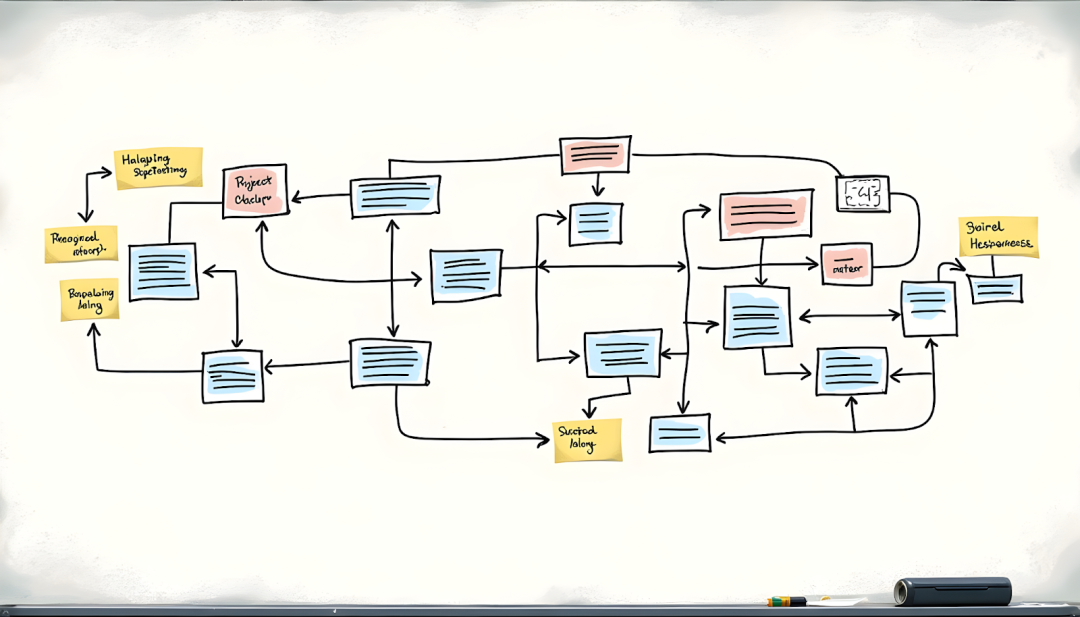
Process is the ability of an organisation to flow in an aligned way, reducing friction, misunderstanding, duplication and focusing on what is most important.
Imagine the flow of work being unencumbered by unnecessary steps, paperwork, conflict or management approval, it can reduce the time it takes to do something in surprising ways.
Good process is one of the most powerful ways to create new capacity in your organisation. It’s much cheaper than throwing people at the problem. Often who you need to hire next can be clearly identified when the process is clear. If the process is clear, roles are clearer, expectations are explicit instead of implicit and everyone has a better understanding of what the business/organisation needs from them. This buys time and sharpens focus.
Structure and scaffolding

Scaffolding is what you use to build something, before it can stand on its own.
I think of structure in an organisation as the scaffolding that allows people to be structured and clear as they are building, making or creating something. It might look like role descriptions and regular check-ins with your team to understand how they are doing, or it might look like a communication framework that allows everyone to know what’s going on so they can make decisions. It may be a formalised financial performance meeting. All these are ways of organising people, work and resources within a clear design, helping everyone understand and make sense of what can often be chaotic, unclear and subsequently exhausting. Fundamentally this is about capacity and sustainability.
The importance of emergence
It is critical to understand that at different times in an organisation’s lifecycle it’s going to need different processes and structures. Processes need to be developmentally appropriate. What is useful to 10 or 15 people no longer works for 30. What worked for 30 is not going to work for 120. This means that you have to get comfortable with the fact that process and structure will be emergent and will need to be adaptable as the business/organisation grows or shrinks. I noticed during COVID that a number of organisations shrank their numbers, and counterintuitively became more productive and efficient. No one saw that coming! Growing is not always a function of the team getting bigger.
Leveraging time and ability

The time it takes to map out the process flow, especially in a smaller organisation is worth every minute spent on it. The return on investment can be hundreds of hours of wasted time identified, reduced and eliminated. It creates awareness in team members about where things can fall into gaps and get lost. It can assist team members to realise how important their ‘small’ piece is to another department, and how critical it is to the overall success of the organisation. It identifies blocks in the system that devour time. It identifies gaps in the team, where there may be a need for a very specific skill set, or a general skill set. Mostly it gives people time back, a lot of it.
One of the unexpected outcomes of a process like this, is that the team develops an understanding of what happens across the business. This means they can identify problems that might affect other parts of the business and can be proactive in solving or communicating. There is a beautiful alignment that happens and people often express gratitude for understanding what everyone else does and how they fit into the larger picture.

If you are interested in finding out more about how to create useful process in your organisation contact Mignon at Mignon@thestrategycircle.co.za